Why Short-Form Content Feels More Addictive Than Netflix or Long Videos
Key Takeaways
- Short-form feeds remove friction. Netflix still makes you choose, commit, and hit natural stopping points. TikTok and Reels start instantly and never really end.
- Frequent novelty hits are harder on your attention. The reward pattern looks more like a variable-reward loop than a narrative arc.
- Recovery depends on reintroducing friction. Tools like ScrollGuard can help by removing the trigger while your brain relearns slower reward patterns through neuroplasticity.
You’ve likely experienced the "Netflix Dilemma": you spend 20 minutes scrolling through titles, reading synopses, and checking IMDB ratings, only to realize you’re too tired to commit to a 45-minute episode. You close the app, open Instagram, and "just check one Reel."
Ninety minutes later, you’re still there. You’ve watched 200 different videos, your neck hurts, and you’re wondering where the night went. How did a platform that requires zero commitment end up taking more of your time than a multi-million dollar cinematic production?
The answer lies in the psychological concepts of friction, commitment, and the "Machine Gun" nature of modern dopamine delivery.
1. The Frictionless Trap
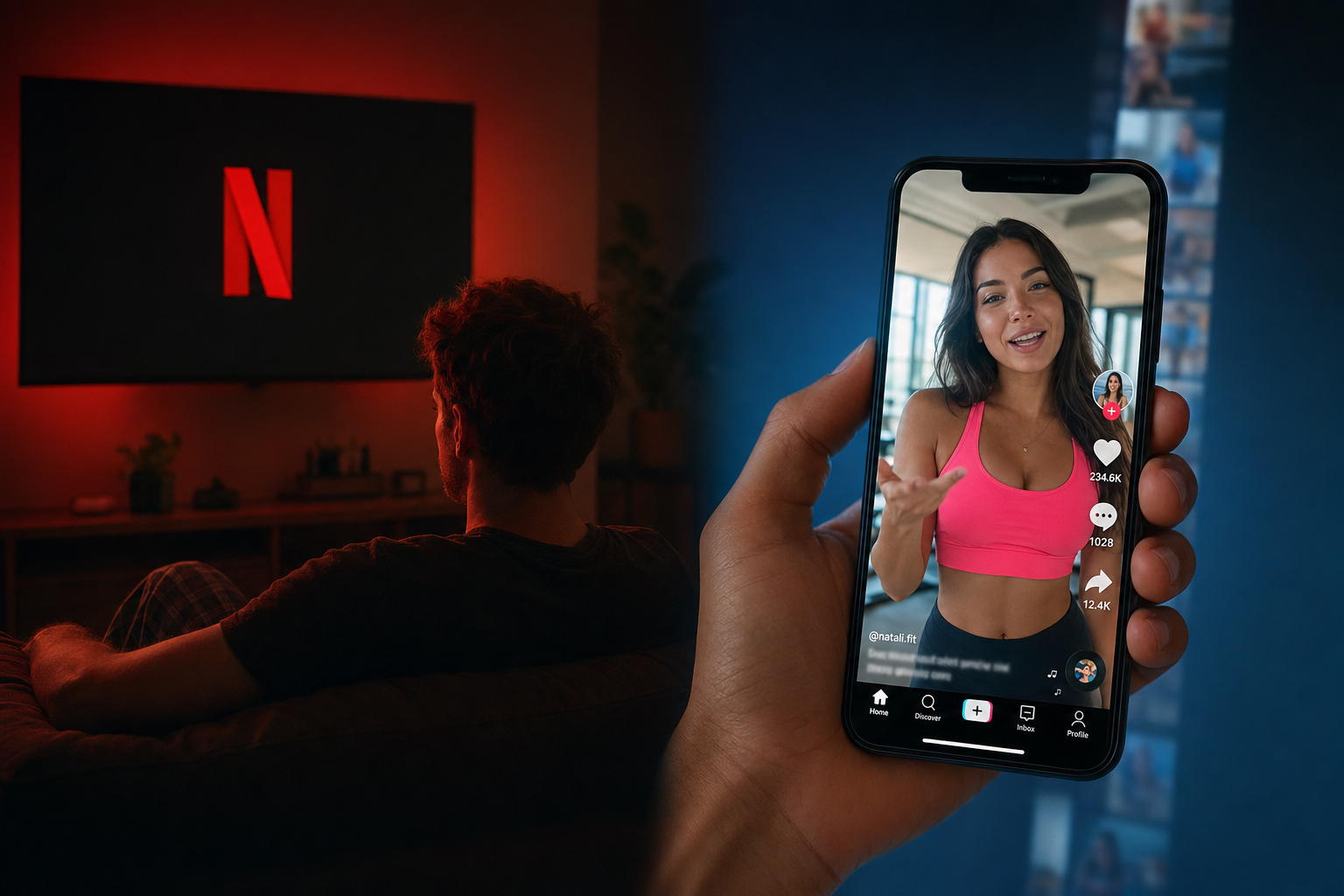
In product design, "friction" is anything that slows a user down. Netflix has a significant amount of friction. To watch a movie, you must:
- Open the app.
- Navigate a grid of dozens of options.
- Make a conscious choice (High cognitive load).
- Commit to a specific duration (1-2 hours).
Short-form video eliminates this entire process. When you open TikTok or Reels, the content starts immediately. There is no grid. There is no choice. The platform chooses for you. By removing the "choice" phase, the app bypasses your prefrontal cortex—the part of the brain responsible for executive function and decision-making—and speaks directly to your primitive reward centers.
Friction Comparison
High Intent Needed
Clear Stopping Points
Low Intent Needed
Infinite Loop
2. The Commitment Paradox
Psychologically, we are more likely to start a task if it feels "small." A 2-hour movie feels like a mountain to climb. A 15-second video feels like a grain of sand. You tell yourself, "I'll just watch one," and because the cost is so low, your brain says "Why not?"
But because there is no stopping cue, you continue to make that "tiny" decision every 15 seconds. This is the "sunk cost" of attention: you don't feel like you're losing time because each individual unit of time is negligible. However, in the same way that 1,000 pennies still make 10 dollars, 400 "small" videos still make a 3-hour binge.
3. Netflix and Decision Fatigue
Research on Decision Fatigue shows that as the day goes on, our ability to make high-quality choices diminishes. This is why we are most susceptible to scrolling late at night. Choosing a movie on Netflix requires "System 2" thinking—conscious, slow, and effortful. Scrolling Reels uses "System 1" thinking—fast, instinctive, and emotional.
When you are tired, Netflix feels like "work." TikTok feels like "rest." Paradoxically, because TikTok is less cognitively demanding to start, it is much harder to stop.
4. Machine Gun Dopamine vs. Narrative Arcs
In our previous post on why TikTok is so addictive, we explored the Dopamine Loop. To understand the difference between Netflix and TikTok, think of it as a Narrative Arc vs. a Variable Reward.
A movie builds tension over an hour. The "payoff" comes at the end. In a TikTok feed, the payoff happens every few seconds. You are getting "Machine Gun Dopamine"—rapid, high-frequency bursts that never allow your reward system to reset to baseline. This creates a state of "flow" that is actually a form of hypnotic trance, often called Doom Scrolling.
5. The Fragmentation of Attention
Perhaps the most damaging difference is how these media types affect your brain long-term. Watching a long-form video (like a documentary or a feature film) requires sustained attention. This strengthens the neural pathways in your prefrontal cortex.
Short-form content requires fragmented attention. You are constantly switching contexts—from a cooking video to a war update to a dance trend—within seconds. This "context switching" is exhausting for the brain and, over time, can reduce your ability to focus on complex, long-form tasks. It’s not that you "don't have time" for a movie; it's that your brain has been trained to reject anything that doesn't provide a novelty hit every 30 seconds.
Reclaiming Your Focus
The goal isn't to live in a cave without technology. The goal is to move from Passive Consumption to Intentional Usage.
- Re-introduce Friction: Use tools like ScrollGuard to block the "Infinite Feed" while keeping the useful parts of the apps.
- Schedule Your Binge: Decide *before* you open your phone that you will watch a specific 20-minute video or 1-hour movie.
- The "One-Scroll" Rule: If you must watch Reels, set a physical timer for 10 minutes. When it rings, the "low-friction" spell is broken.
Remember: Netflix wants your subscription, but TikTok wants your agency. By understanding the neuroscience of the scroll, you can start making conscious choices again. If you want the behavior change version of that idea, start with how to make your phone less addictive in 15 minutes, or compare tools in best apps to stop doomscrolling.
Want the receipts? 50+ short-form video addiction statistics covers the watch-time data, the leaked TikTok internal documents, and the mental health correlations behind everything in this post.
Frequently Asked Questions
Why does TikTok feel easier to binge than Netflix?
Because the next video starts instantly and the choice cost is almost zero. Netflix makes you browse, decide, and commit. Short-form feeds remove that friction.
Does long-form video affect your attention differently?
Usually yes. Long-form video asks for sustained attention and has clearer stopping points, while short-form feeds rely on novelty and fast context switching.
What is the practical fix if short-form video keeps pulling you in?
Reintroduce friction. That can mean timers, fewer visual cues, or removing the infinite feed entirely with a tool like ScrollGuard.
Scientific Sources & Authority
- Dr. Anna Lembke: Dopamine Nation: Finding Balance in the Age of Indulgence. (Explores the biological basis of modern addictions).
- Ophir, E., Nass, C. & Wagner, A. D. (2009). Cognitive control in media multitaskers. PNAS. Study on how rapid context switching affects executive function.
- Stanford Medicine: The neuroscience of the "Variable Reward" schedule in social media.
- Stanford Medicine: Accessible explanation of the variable-reward dynamics behind addictive social feeds.
Take Back Your Agency
ScrollGuard allows you to keep Instagram and YouTube while removing the addictive 'Infinite Scroll' triggers.