
How to Break Phone Addiction: Symptoms, Science, and a 5-Step Plan
Key Takeaways
- Phone addiction is not officially in the DSM-5, but the behavioral pattern (loss of control, tolerance, withdrawal-like symptoms, continued use despite harm) matches the same criteria used for gambling disorder.
- The symptoms are recognizable: phantom vibrations, anxiety when separated from your phone, picking it up without intention, lost time, sleep loss, and failed attempts to cut back.
- The science explains why willpower fails: heavy use measurably reduces prefrontal cortex activity, which is the part of your brain that would otherwise tell you to stop.
- Deleting apps usually backfires. Most addictive behavior comes from a small number of feed surfaces (Reels, Shorts, TikTok For You), not from the apps themselves. Surgical blocking is more sustainable than nuclear options.
- The 5-step plan in this article: audit your real usage, remove visual triggers, block the feeds with ScrollGuard, engineer friction into your environment, and replace the loop with something your brain actually wants.
Most articles about phone addiction either lecture you about discipline or tell you to do a 30-day digital detox and then go back to the same setup that got you here. Neither works for long.
This guide takes a different approach. First we look at the actual symptoms of phone addiction so you can tell the difference between "I use my phone a lot" and "my phone is using me." Then we cover the neuroscience of why your brain keeps reaching for it even when you do not want to. Finally we walk through a five-step plan that does not depend on willpower, because by the time you need willpower, you have already lost the battle.
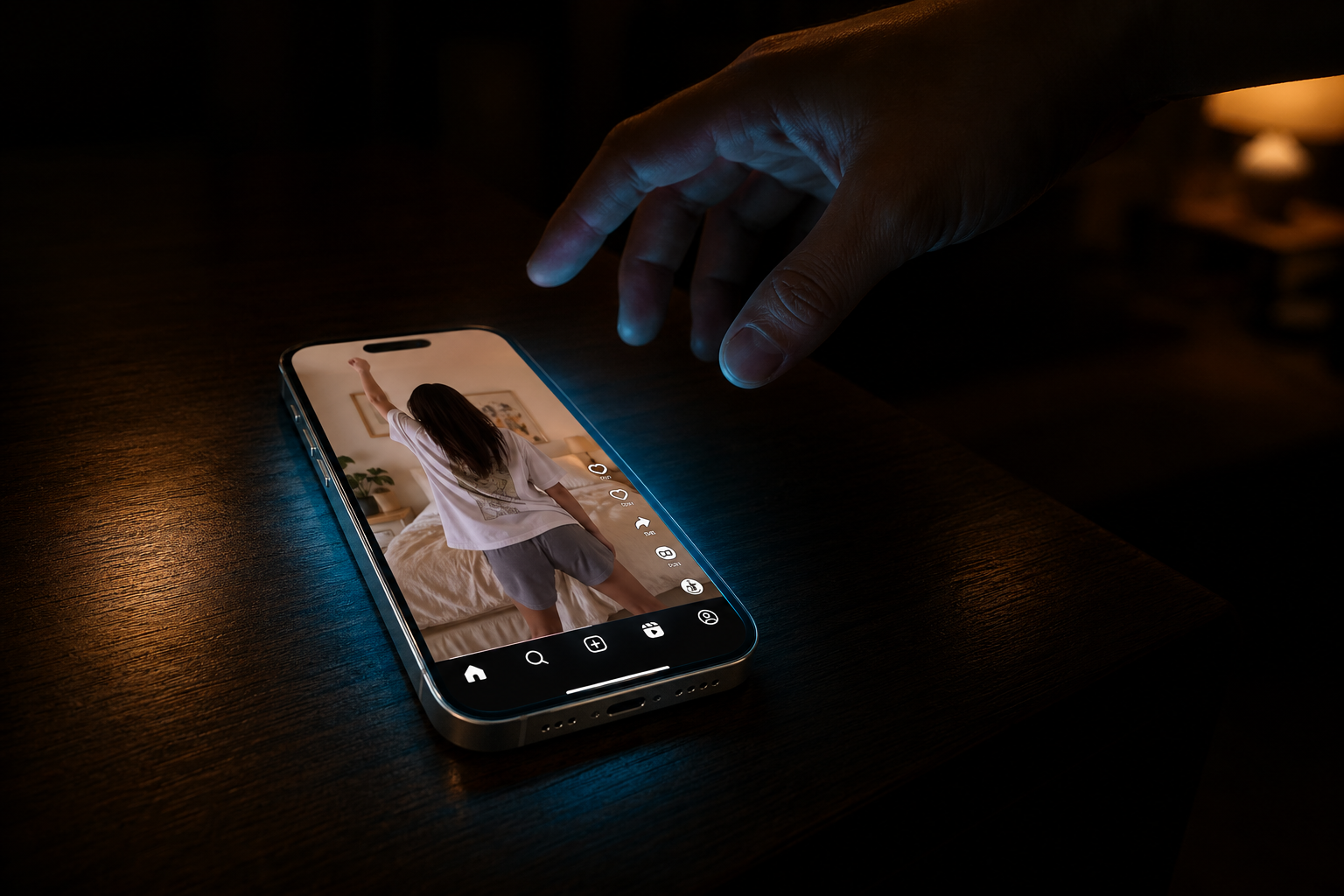
Is This Really Addiction, or Just a Bad Habit?
Strictly speaking, "phone addiction" is not a clinical diagnosis. The DSM-5, the manual psychiatrists use to classify mental health conditions, recognizes gambling disorder as a behavioral addiction, and lists internet gaming disorder as a condition that warrants further study. Smartphone or social media addiction is not yet officially classified.[1]
That does not mean researchers think it is fake. It means the field is still arguing about how to draw the line. The most widely used research instrument is the Bergen Social Media Addiction Scale (BSMAS), which adapts the same six core criteria used for substance and gambling disorders: salience (the activity dominates your thinking), mood modification, tolerance, withdrawal, conflict with other parts of life, and relapse after attempts to cut back.[2]
If you can check most of those boxes for your phone, the label matters less than the pattern. Whether we call it "phone addiction," "problematic smartphone use," or "compulsive scrolling," the behavior, the brain changes, and the strategies that fix it are largely the same.
The Symptoms of Phone Addiction
Below are the symptoms researchers and clinicians most commonly associate with problematic smartphone use. They fall into three categories: behavioral, emotional, and physical.
Behavioral symptoms
- Reaching for your phone within seconds of waking up, before getting out of bed or speaking to anyone in the room.
- Picking up your phone dozens of times a day with no specific reason. You unlock, glance, swipe through a screen, and lock it again, often without remembering why you reached for it.
- "Just one quick check" turning into 30 to 60 minutes. You meant to look at one DM and ended up deep in the Reels feed.
- Repeated failed attempts to cut back. You delete an app, reinstall it within a week. You set a screen time limit, you tap "Ignore Limit" within a day.
- Scrolling instead of doing things you said you wanted to do. The book on your nightstand has been on the same chapter for two months.
- Using your phone in inappropriate or unsafe contexts. Checking it during conversations, in meetings, while driving, while walking across the street.
Emotional symptoms
- Anxiety when your phone is not within reach, even for short periods. Researchers call this "nomophobia," short for "no-mobile-phone phobia." It has been a measurable phenomenon in the literature for over a decade.[3]
- Restlessness, irritability, or low mood when you cannot use your phone, such as during a flight or in a dead zone.
- Phone use as your default mood regulator. When you are bored, anxious, sad, or under-stimulated, the phone is the first thing you reach for.
- Guilt or regret after long sessions, followed by another long session shortly after. This is the "what the hell" effect: feeling bad about scrolling, then scrolling more to escape feeling bad.
Physical symptoms
- Phantom vibrations or notifications. You feel your phone buzz in your pocket, only to find that nothing happened. One undergraduate study found this in roughly 89% of regular smartphone users.[4]
- Sleep loss. Bedtime scrolling pushes back sleep onset and shortens sleep duration. Phone use within the hour before bed is consistently associated with worse sleep quality.[5]
- Eye strain, neck pain ("tech neck"), and tension headaches from prolonged screen use.
- Reduced fine-motor rest. Your thumb is doing thousands of micro-movements per day that it never evolved to do.
If three or four of these are recognizable, you are in the territory researchers describe as problematic smartphone use. If most of them are recognizable, this article is probably overdue for you.
A 60-Second Self-Test
Answer honestly. There is no score, only a pattern.
- If you had to guess your daily screen time without checking, would your guess be lower than the real number?
- In the last week, did you pick up your phone with a clear intention and then end up doing something completely different for 20+ minutes?
- Have you ever tried to cut back on a specific app, failed, and then stopped trying?
- Do you feel a low-level anxiety when your phone is in another room or has under 20% battery?
- Do you check your phone during conversations, meals, or in the bathroom by default?
- Has anyone close to you (partner, friend, family) commented on your phone use in the last six months?
- If you imagine going 24 hours without your phone, does that feel uncomfortable rather than relaxing?
Three or more "yes" answers is a strong signal that the relationship is no longer one-way. Your phone is also using you.
The Science: What Is Actually Happening in Your Brain
Phone addiction is not about the device. It is about what specific apps and feeds do to the brain's reward system. Three mechanisms do most of the work.
1. Variable-ratio reinforcement
Slot machines and short-form video feeds use the same psychological mechanism: rewards delivered on an unpredictable schedule. You do not know if the next swipe will be funny, interesting, attractive, infuriating, or boring. That uncertainty is exactly what trains the brain to keep pulling the lever. We covered this in depth in why TikTok is so addictive and in why short-form content feels more addictive than Netflix.
2. Tolerance and the dopamine-deficit state
The more you scroll, the less dopamine each individual video releases. Your brain adapts to the artificially elevated baseline. When you put the phone down, dopamine levels drop below your normal resting state, which feels like boredom, restlessness, low mood, and an itch to pick the phone back up. This is the same general pattern observed in other behavioral and substance addictions.[6] Our piece on what actually works in a dopamine detox goes deeper on the recalibration timeline (multi-week, not 24 hours).
The practical consequence is that scrolling does not stop being attractive once you have scrolled "enough." It usually becomes more attractive, because you are now using it to escape a low you created.
3. Reduced prefrontal-cortex activity
The prefrontal cortex is the part of your brain responsible for impulse control, planning, and stopping behavior in progress. Brain imaging studies of heavy social media users show measurable decreases in activity in this region, matching the patterns seen in recognized substance and behavioral addictions.[7]
This is the most important fact in the whole conversation: the more you scroll, the harder it becomes for your brain to tell you to stop. That is not a metaphor. Imaging studies tell a consistent story: a 2017 neuroimaging study of social-media-addicted users found grey-matter reductions in the amygdala, paralleling structural changes seen in substance addictions,[10] alongside the reduced prefrontal activity already cited above.[7] This is also why "just have more discipline" is not a strategy. It asks the exact parts of your brain that the addiction has already weakened to do all the work. (If you have ADHD, the executive-function piece is impaired before scrolling enters the picture — the phone rules that actually work for people with ADHD covers the specialized version.)

The takeaway in one sentence
You are not weak. You are using a willpower-based strategy against a system specifically designed to defeat willpower, with a brain that the same system has been quietly weakening.
The 5-Step Plan to Break Phone Addiction
Each step targets a different part of the loop. The order matters: do not skip step 1 to jump to the tactical changes. Without an honest baseline, you will not know whether the rest is working.
Step 1: Take an Honest Audit
Before you change anything, look at the actual numbers. Most people underestimate their daily screen time by 30 to 50%. Guesses are useless. The data is on your phone already. (For the population-level picture, our short-form video addiction statistics page has the average daily-time data across platforms.)
- iPhone: Settings > Screen Time > See All App & Website Activity. Look at the last 7 days, not yesterday.
- Android: Settings > Digital Wellbeing & parental controls > Dashboard. Same: weekly view, not daily.
Write down three numbers:
- Total daily average across the week.
- The single app you spend the most time in.
- Pickups per day (how many times you unlocked the phone).
Now ask one question per number: Is this number higher than I am comfortable with? Not "is it average for my country." Not "is it lower than my friend's." Higher than you are comfortable with.
The answers form your baseline. In two weeks, you will check the same three numbers and compare. Without this step, you will not know whether your changes worked or whether you just feel better because you finally took some action.
A more useful exercise
For one normal day, every time you reach for your phone, ask: What was I about to do, and what am I actually about to do? The gap between those two answers is the size of your problem. Some days the gap is small. The days that worry you are the ones where it is enormous.
Step 2: Remove the Visual Triggers
Your brain is constantly scanning for cues. Bright app icons, red notification badges, autoplay thumbnails, and home-screen grids are all designed as cues. Each one is a small, low-effort invitation to start a session you did not plan.
The fastest visual changes you can make in 15 minutes:
- Turn on grayscale. The single biggest change you can make at the system level. It strips the colorful, slot-machine aesthetic out of every app at once.
- Take social and video apps off your home screen. Bury them in the App Library or app drawer. You can still get to them, but only by typing the name.
- Turn off every notification badge except direct human messages. No red dots for "trending," "someone you might know," "weekly recap," or any other algorithmically generated alert.
- Mute or kill notifications from apps that do not contain a real person trying to reach you. If a notification cannot be ignored, it should come from a human.
For the exact settings paths and a few more tactical moves, the companion piece how to make your phone less addictive in 15 minutes walks through everything in order.
Step 3: Block the Feed, Not the App
Most "delete the app" advice fails for the same reason crash diets fail: it confuses the addictive substance with the container. The container is Instagram. The substance is the Reels feed. The container is YouTube. The substance is Shorts and the recommendations sidebar. The container is Reddit. The substance is the front page and infinite scroll.
Deleting the container costs you the things that are actually useful: messaging, communities, event invitations, subscriptions to creators you chose to follow. Within a week or two, you will reinstall, because the cost was real and the relief was small.
A more durable approach is to block only the addictive feed surfaces and keep everything else. ScrollGuard is built specifically for this:
- Keep Instagram. Block Reels. Keep DMs and stories.
- Keep YouTube. Block Shorts. Keep subscriptions, search, and full-length videos.
- Keep TikTok or remove only the For You feed.
- Keep Reddit. Block the home feed. Keep subreddits you actively chose.
The reason this works better than "delete everything" is that it removes the trigger without removing the social value. Your prefrontal cortex no longer has to win the same micro-battle 80 times a day, because the feed simply does not load. If you want a comparison of this approach against the more common "block whole apps" tools, the roundup in best apps to stop doomscrolling covers the trade-offs.
Step 4: Engineer Friction Into Your Day
Visual triggers and feed blocking handle the phone itself. This step handles the moments when your phone is hardest to resist: first thing in the morning, in the evening, in bed, and any time you sit down to do real work.
The principle is simple: increase the physical or temporal distance between you and your phone in the moments that matter most. Each step here is small, but they stack.
- Charge your phone outside the bedroom. If you use your phone as an alarm, buy a $15 alarm clock. The single biggest predictor of a wasted morning is whether your phone was within arm's reach when you woke up.
- No phone for the first 30 minutes after you wake up. Get out of bed, drink water, do whatever your morning routine is, then check it.
- Phone out of the room when you do focused work. Not face-down, not on silent, not in a drawer at the desk. In another room. Even a phone you can see but never touch reduces available cognitive capacity.[8]
- Hard cutoff at night. Pick a time. After that time, the phone is not in the room. If your evenings are the worst part of your phone use, the bedtime-specific tactics in how to stop doomscrolling at night are worth their own session.
None of these requires you to be more disciplined in the moment. They all change the physical environment so that "just one quick check" is no longer cheap.
Step 5: Replace the Loop, Don't Just Cut It
This is the step most plans skip, and it is also the one that decides whether the changes hold past week three.
Your phone has been doing real work for you. It has been a boredom-killer, a mood-regulator, a sleep aid, a social-anxiety escape hatch, and a default thing-to-do whenever you have 30 unscheduled seconds. If you remove all of that without replacing it, your brain will route around the changes. You will reinstall the app, find a new loop, or buy a new device that does the same thing.
The replacement does not have to be impressive. It just has to be available in the same moments your phone used to be.
Keep a real book in the room you spend the most time in. Keep a notebook on your desk. Have one short walk route you can do without thinking.
Step outside for two minutes. Splash cold water on your face. Text one specific person rather than passively consuming. The point is to do something deliberate instead of nothing-with-stimulation.
Keep a paperback or e-ink reader on the nightstand. The goal is not to read 50 pages. It is to give your hand something to reach for that does not light up your brain at midnight.
Walk without headphones. Sit somewhere without your phone. The boredom is not a bug. It is your brain rebuilding the capacity to do nothing, which is also where most of your good ideas have always come from.
For the first one to two weeks, the replacements will feel worse than the phone did. That is the dopamine-deficit state. Your baseline is artificially low. Once it normalizes — clinical estimates put consistent reset at one to three months, with measurable mental-health gains showing up as early as three weeks at ≤2 hours/day in a 2025 RCT[9] — the same low-stimulation activities start to feel satisfying again. This is not optimism. It is the same neuroplasticity that built the addiction in the first place, working in the other direction.
What Recovery Actually Looks Like
If you do all five steps, here is the realistic timeline. Yours may differ, but most people land somewhere in this range.
The hardest stretch. You will reach for your phone constantly out of pure habit. Boredom and restlessness peak. This is the dopamine-deficit state, not a sign that the plan is failing.
The reflex weakens. You start noticing reach-for-the-phone urges before you act on them. Sleep usually improves first. Screen time numbers drop substantially.
The replacements start to feel rewarding on their own. Reading is no longer a chore. Boredom returns to a normal background sensation rather than something painful to escape.
Substantial neurological recovery. Phone use becomes more functional than reflexive. The new defaults feel like the new normal, not like restraint.
Two notes on relapse. First, you will slip. Almost everyone does. Reinstall a feed in a moment of weakness, scroll for an hour at night, lose a Sunday to TikTok. The rule is the same one that works for any habit: never miss two days in a row. One slip is data. Two slips in a row is the start of the old loop reforming.
Second, do not measure success by hitting zero. The goal is not to never use your phone. The goal is to use it on purpose. If your screen time has dropped, your sleep has improved, you remember why you picked it up most of the time, and the apps you do use feel like tools rather than traps, the plan worked.
Frequently Asked Questions
Is phone addiction a real medical condition?
It is not formally listed as a disorder in the DSM-5. Researchers commonly use the terms "problematic smartphone use" or "smartphone addiction" and apply the same six behavioral-addiction criteria used for gambling disorder: salience, mood modification, tolerance, withdrawal, conflict, and relapse. Brain imaging studies of heavy social media users show reward-circuit changes that look similar to those in recognized addictions, even if the formal diagnostic label is still under debate.
What are the most common symptoms of phone addiction?
Reaching for the phone within seconds of waking up, picking it up dozens of times a day without remembering why, anxiety when it is not within reach, losing track of time during sessions, sleep loss from late-night use, scrolling instead of doing things you said you wanted to do, and repeated failed attempts to cut back. Phantom vibrations, where you feel a buzz that is not really there, are a common physical sign.
How long does it take to break phone addiction?
Most people see clear behavioral improvements within 7 to 14 days of removing the main triggers (especially short-form video feeds). Initial neurological recovery typically begins within 1 to 3 months, and substantial recovery commonly takes 3 to 12 months of consistent reduced use. The first 72 hours are usually the hardest because of the dopamine-deficit state, where boredom and restlessness peak before your baseline normalizes.
Do I need to delete social media to break phone addiction?
Usually not. Most of the addictive behavior is driven by a small number of feed surfaces (Reels, Shorts, the TikTok For You feed, the Reddit front page), not by the apps themselves. Tools like ScrollGuard remove the addictive feeds while keeping DMs, stories, subscriptions, and other useful features intact. This tends to be more sustainable than deletion, because deletion removes real social value and often leads to reinstallation within a week or two.
Why does willpower never seem to work for this?
Heavy phone use measurably reduces activity in the prefrontal cortex, which is the part of your brain responsible for impulse control and stopping behavior in progress. The more you scroll, the less effective that brain region becomes at telling you to stop. That is why environment-based interventions (blocking the feed, removing icons, putting the phone in another room) consistently outperform willpower-based ones: they do not depend on the cognitive function the addiction has been weakening.
Are screen time limits enough on their own?
Rarely. iOS Screen Time and Android Digital Wellbeing limits present a choice ("Ignore Limit" vs "OK") at the exact moment your self-control is weakest. Most users dismiss the limit. They are useful as one layer in a larger system, but not as the only line of defense. Pair them with feed blocking and physical-friction changes for a setup that does not collapse the first time you have a hard day.
Should I do a 30-day digital detox?
A multi-week reduction can shift your dopamine baseline, but if you go back to the same phone setup afterward, the old habits usually return within weeks. The longer-term fix is to change the setup itself: block the addictive feeds, remove the visual triggers, build friction into your environment, and replace the loop with something else. A detox without those structural changes is a vacation, not a recovery plan.
Sources
- American Psychiatric Association. Diagnostic and Statistical Manual of Mental Disorders (DSM-5-TR).
- Andreassen, C. S., et al. (2016). The relationship between addictive use of social media and video games and symptoms of psychiatric disorders: A large-scale cross-sectional study. Psychology of Addictive Behaviors, 30(2), 252-262.
- King, A. L. S., et al. (2013). Nomophobia: Dependency on virtual environments or social phobia? Computers in Human Behavior, 29(1), 140-144.
- Drouin, M., Kaiser, D. H., & Miller, D. A. (2012). Phantom vibrations among undergraduates: Prevalence and associated psychological characteristics. Computers in Human Behavior, 28(4), 1490-1496.
- Hale, L. & Guan, S. (2015). Screen time and sleep among school-aged children and adolescents: a systematic literature review. Sleep Medicine Reviews, 21, 50-58.
- Koob, G. F. & Volkow, N. D. (2010). Neurocircuitry of addiction. Neuropsychopharmacology, 35(1), 217-238.
- Stanford Medicine: Addictive Potential of Social Media, Explained.
- Ward, A. F., et al. (2017). Brain drain: the mere presence of one's own smartphone reduces available cognitive capacity. Journal of the Association for Consumer Research, 2(2), 140-154.
- BMC Medicine (2025): Smartphone screen time reduction improves mental health: a randomized controlled trial.
- He, Q., Turel, O., & Bechara, A. (2017). Brain anatomy alterations associated with Social Networking Site (SNS) addiction. Scientific Reports, 7, 45064.
Block the Feed, Keep the App
ScrollGuard removes the addictive parts of Instagram, YouTube, TikTok, and Reddit while keeping your DMs, stories, and subscriptions intact. The cleanest way to start step 3 of the plan above.